To do well in VCE Arguments and Persuasive Analysis (Section C in the Year 12 Exam) you must do more than just identify techniques and work out why one word is placed or juxtaposed with, or contrasts with, another word. I can get my Year 7s to identify anecdotes, expert opinion, rhetorical questions and inclusive and emotive language — the typical “go-to” features.
However, it takes experience and practice to work out which are the most salient features of an author’s argument. Which techniques complement each other in order to support the author’s viewpoints? Which techniques should I focus on? And how should I group these together? It is relatively easy to try to explain everything; it is harder to be selective.
Like a text response essay, you must control your paragraph. You must avoid the random extended list-type paragraph, because “”I’m not quite sure which are the most important emotive words-techniques”. Avoid repetition. Avoid generic statements.
Rather, you must move from the ‘broad” to the “specific”. You need to have a strong awareness of the author’s viewpoints, complementary argument techniques and supportive word choices. Then you can keep analysing audience segments and positioning tactics.
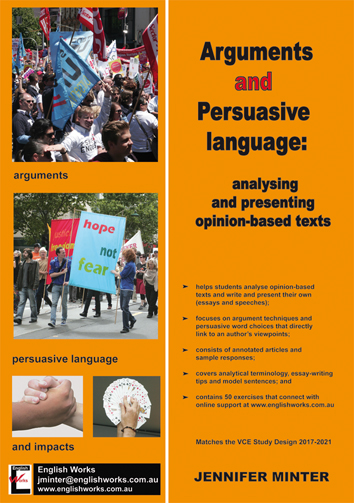
This latest workbook (Arguments and Persuasive language: analysing and presenting opinion-based texts (2020) helps you group techniques intuitively so that you can arrive at a clear, sharp and simple structure. This is the only way to improve your analysis of “purpose”, the author’s intended impacts and their positioning strategies.
To write an effective comparison, you must have a good grasp of the “broad’ features of an author’s argument.
I also run Zoom Classes in conjunction with this workbook. For enquiries, please email: jminter@englishworks.com.au