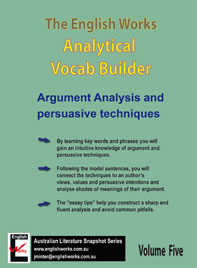
Please work through our Suggested Responses for the Exercises in the Vocab-Builder to normalise a critical vocabulary.
You have to use “relevant metalanguage” but you can’t “technique label”. You have to identify viewpoints and work out how argument and language complement each other. You can’t paraphrase or summarise but you need to evaluate the author’s techniques/word choices and their “intended effects”.
What is the difference between summarising and analysing?
You have to hone in on the techniques that best reinforce the author’s viewpoints and evaluate the word choices associated with these techniques.
Here’s how: Suggested Responses for the Exercises in the Vocab-Builder
Note the difference between sentences that summarise and sentences that analyse:
Summary-style: Ms Timms claims that jaywalkers do not ‘give a flying thought to anything’.
- Analytical-style: Ms Timms discredits jaywalkers because they do not “give a flying thought to anything”.
Summary-style: Ms Timms also calls upon “jaywalkers” to show more concern for the safety of other road users.
- Analytical-style: Appealing to safety concerns, Ms Timms implores “jaywalkers” to show greater respect for motorists and other pedestrians.
Summary-style: Mr Barry uses inclusive language, such as “we should all follow suit” to appeal to all members of the audience and to show that they care.
- Analytical style: Mr Barry’s inclusive reference to “all those who care” is designed to morally challenge those who fail to show respect for the senseless slaughter of the minke whales.
This booklet contains all my favourite metalanguage that I use to write efficient responses that ticks off all boxes. It also offers a guide to writing a smart and streamlined structure.
How to write an A+ response, please see VCE Section C: Suggested Responses.
This A5 booklet (carry-size) enables students to learn the metalanguage and then focus on the meaning of the text. Students from Years 8 to 10 will effortlessly and intuitively learn all the relevant techniques.
Cost: $15; $10 bulk orders.