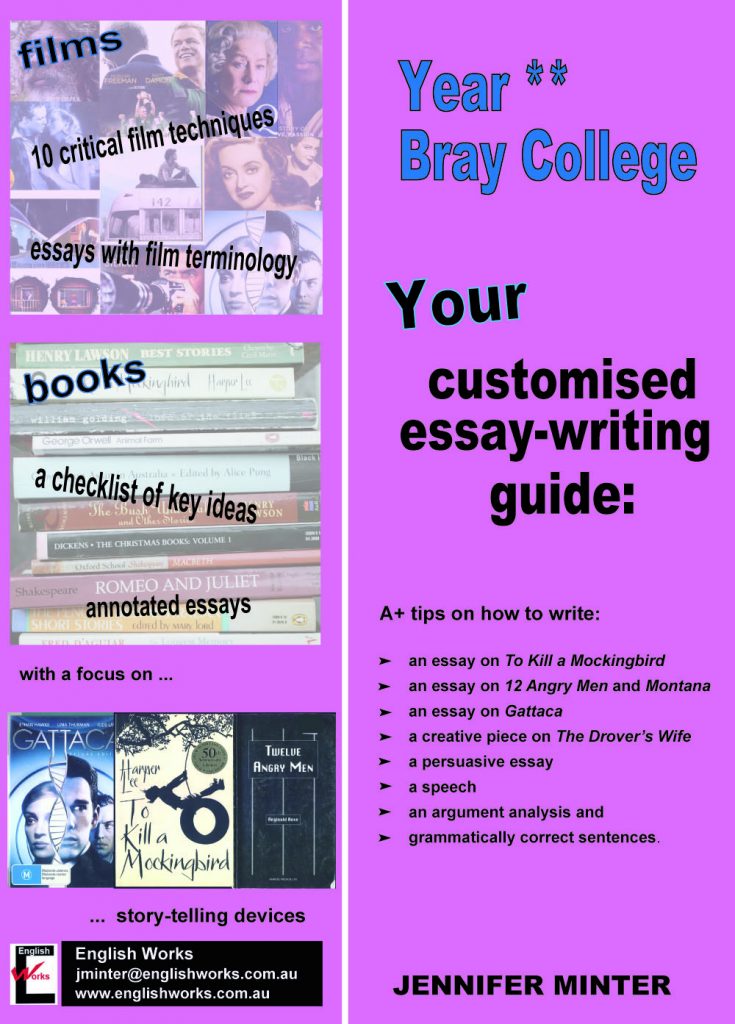
Thank you for your feedback and requests! Here it is!
Please enquire about our special deals for teachers/schools.
See our Product page for more details.
Every page counts!
With an emphasis on essay-writing, our Text-specific Customised Workbook enables students to access relevant essay-writing information in the one workbook. It includes chapters on the students’ specific texts (analytic, creative and book pairs) and “how to improve” advice; it also includes year-specific argument analysis resources and relevant metalanguage/model sentences across the study design.
Choose your own chapters from our wide range of resources.
Chapter 1: How to write an essay on a text
Detailed tips include how to:
- write relevant and pointed topic sentences;
- compile a checklist of the author’s key ideas;
- maximise analytical depth and avoid story-telling;
- summarise the author’s key narrative (story-telling) devices and their link with the author’s narrative intentions.
- hone in on key points of evidence and quotes with an analytical story
- gain depth and
- show a logical progression of thought.
This chapter includes sample plans and essays.
Include a chapter from your prescribed text with a detailed summary of themes, key ideas, story-telling devices and sample essays and plans.
Chapter 2: How to write an essay on two texts
- Follow the tips in Chapter 1. Plus
- Keep a checklist of each author’s key ideas and key concepts.
- Zoom in on textual examples and quotes that reveal similarities and differences. Condense the evidence to its most essential points.
- Keep a checklist of each author’s key narrative devices. Use the “language of comparison” and fine-tune your cross-referencing strategies.
- A typical structure for a comparative essay.
- Sample paragraph plans and model essays.
Include a chapter from your prescribed texts with a table of similar themes, key ideas, story-telling devices and sample essays and plans.
Chapter 3: How to write an essay on a film
- Revise the 10 tips in Chapter 1.
- Construct a table identifying the film’s key scenes, quotes and context.
- Keep a checklist of the director’s key ideas.
- Analyse a cluster of film techniques that occur within a cinematic frame and within a series of frames. (Sample paragraphs)
- Write a list of 10 key film techniques.
- Plan a paragraph (embedding film techniques)
- Plan and write your essay
Chapter 4: How to write a creative piece
- This chapter includes tips to help students devise a neat and effective structure, including a short narrative and a monologue-style piece.
- The tips cover strategies to “show” and not “tell, including the depiction of relatable characters, the use of dialogue and descriptions and story-telling devices.
- The tips give students confidence to explore ways to enhance suspense and impart a message.
- Read the five story models and, following Robert Louis Stevenson’s advice, try to “ape” their qualities.
Chapter 6: How to script and deliver your speech
- Structure of a persuasive text or a speech: model speeches
- How to incorporate persuasive techniques to advantage
- The key features of a Statement of Intention: model
- (See Chapter 10, Arguments and Persuasive Language: writing and presenting an opinion, 2020)
Chapter 7: How to write an argument analysis: features of your essay
Excerpts from Arguments and Persuasive Language: analysing and presenting opinion-based texts (a smarter and streamlined way of analysing arguments)
- This chapter includes 10 argument and persuasive techniques
- Sample pages from our wide range of language analysis resources. (Choose your own.)
- How to write analytical sentences (tying the technique to the context).
- How to write a smart paragraph
- How to write essays: for example a comparative-style essay.
Chapter 8: How to write clear sentences
An awareness of 10 rules of grammar will help students write clearer sentences. This chapter includes sample sentences and exercises on each rule.
- A clause must have a subject-verb combination
(Where is the subject? Where is the finite verb?
“Dangling phrases” and non-finite clauses often lack a grammatical subject.) - Verb-object: some verbs take an object
(difference between transitive and intransitive verbs) - Tenses must be consistent: using present tense in text analysis
- Pronoun references must be clear and consistent
(awareness of pronoun references can minimise grammatical confusion) - Relative pronouns: “who” and “that” and agreements.
- Clause structures
(avoid sentences with multiple clauses: one clause often lacks a subject; avoid run-on sentences) - Use active rather than the passive voice
(The passive often leads to awkward grammar or subjects become detached.) - Use nominals rather than awkward “how” and “that” clauses
(Aim for lexical density; be as concise and precise as possible) - Avoid dangling or unattached phrases: phrases and control of the subject
- A list must consist of the same parts of speech.
(Tripling devices and compound predicates often lead to awkward grammar – a detached subject)