• Skip to main content
  • Skip to primary sidebar
  • Skip to footer

English Works

  • Home
  • Our Shop
    • Books
    • Year 12 Frameworks Crafting Texts
    • Argument Analysis
    • Year Level Packages
  • Years 7 – 10
    • Techniques of Persuasion Program
    • Become an Expert Program
      • The English Works Analytical Vocab Builder
    • Better Essays & Persuasive Techniques
    • Grammar & Language (Blue)
    • English Works Classic Short Stories by the masters
  • Years 11-12
    • Oedipus the King by Sophocles: an essay-writing guide
    • Sunset Boulevard : How to Write an A+ Essay
    • Rainbow’s End by Jane Harrison: an essay-writing guide
    • English Works Reader Blue Book
    • Year 11 & 12 Argument Analysis
      • VCE Argument Pack
      • The English Works Analytical Vocab Builder
      • VCE Section C: Suggested Responses
    • Year 12 Frameworks About Country
    • Year 12 Frameworks About Personal Journeys
      • Year 12 Frameworks About Play
      • Year 12 Frameworks About Protest
      • Crafting texts: Year 11 About Crisis
  • Classes
    • Our Classes 2026
  • Contact us

“Digging deeper” – focus more on author’s intentions/purpose/intended effects and positioning strategies (14th April)

April 14, 2023

Teacher’s feedback

Most feedback is related to the need to “dig deeper” in order to improve the analysis of the author’s intended effects — that is, the use of argument and written language to persuade others to share the points of view presented.

To gain depth of analysis you need to work on your persuasive word-level analysis. But, firstly, to avoid a random list, you need to understand the author’s views/argument in a holistic way so that you can show how the parts fit together.

Firstly, clearly articulate the author’s viewpoints and call to action. Also show a smart awareness of the argument strategies used to support these viewpoints. (ie. “construction of argument”)

This will ensure that you have a good grasp of the key word choices/phrases that are critical to the author’s intentions.

Then keep digging. Do not isolate words and phrases; do not compile a list. You will reach a dead-end with your analysis. Plus you will be generic, vague and repetitive. Do not write, the ” author then states, then goes on to say, then goes on to prove, then concludes”

Rather:
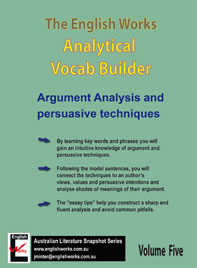
  • underline, and group together, key persuasive word choices;
  • consider how they reinforce and complement each other;
  • consider how they support the author’s intended effects/call to action
  • work your metalanguage in a polished and nuanced way;
  • circle around the chunk (forwards and backwards); and use quotes smartly; as proof of the author’s call to action and intended effects;
  • See emotive language; analyse at least two intended effects (See pp 26-30) and work your segmented audiences.
  • See comparisons/juxtapositions and connotations – extrapolate the implications and their intended effect on segmented audiences (See p. 13/43)
  • Watch your quoting – be careful with long quotes (rhetorical questions – use dashes). Do not quote “we” as in “inclusive language”; it is meaningless. Quote a longer phrases and analyse associated techniques.
Tweet

2023 Argument Analysis Classes, Uncategorized

Jenny

Products

  • 2026 Zoom in for Term 1: 4 lessons (Argument Analysis and Craft of Writing) $160.00 $130.00
  • Rainbow's End by Jane Harrison: an essay-writing guide $28.95
  • Twelve Angry Men by Reginald Rose: how to write an A+ essay $24.95
  • Oedipus the King by Sophocles: an essay-writing guide $28.95
  • VCE Argument Pack $65.00

Primary Sidebar

View all Products in this Category

Cart

Search

Footer

For Sponsorship and Other Enquiries

Please contact English Works
Ph: (061) 0400 568 657
or email:jminter@englishworks.com.au
Original artwork by Kelly Bull

Keep in touch

Search

Copyright © 2026 English Works · Log in