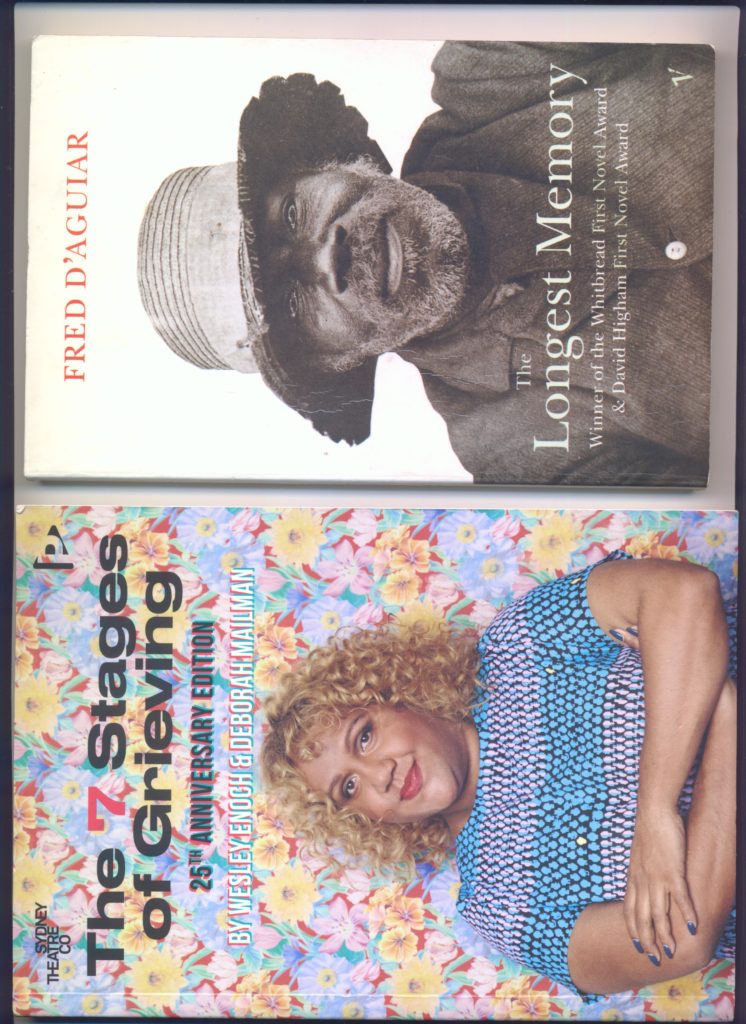
2020 marks the 25th anniversary of the first production of The 7 Stages of Grieving by Deborah Mailman and Wesley Enoch.
The collaborative play consists of 24 vignettes that portray aspects of colonisation from the perspective of the First Nations people. It is told by one Woman (a collective voice – an “Everywoman”) who uses various story-telling styles and adopts numerous personas to explore the range of experiences and emotions that characterise the “millennia of traditions” and the loss of Country.
The dominant emotion of grief remains a constant throughout each vignette. It was grief that provided the initial impetus. Mailman and Enoch state, “we both had family moments around grief and grieving and hence we started to talk about grief as a constant in our lives, in the lives of most Indigenous Australians.
This play is a parody of the 5 Stages of Dying as identified by Elizabeth Kubler-Ross.
These stages are: denial, isolation, anger, bargaining, depression and acceptance.
The play focuses on the 7 phases of Aboriginal History: dreaming; invasion; genocide; protection; assimilation; self-determination and reconciliation.
“Living in the moment”: a living work of art
From its inception, the playwrights envisioned a play that would be a living document, edited and revised to “speak new versions, new stories” and keeping it “open to the new influences”. They suggest that the 8th phase, Treaty or Sovereignty, would be the “additional scene”. Public debate has focused on a change to the Australian Constitution in order to recognise the First Nations People as the first Australians. The famous Uluru Statement from the Heart Statement advocates for a Voice to Parliament in the Constitution.
They acknowledge that there is scope for change, re-interpretation and rewrites to reflect new perspectives and attitudes. They invite producers to “find the right way for them to stage it”.
The play integrates a variety of art-forms: story-telling, dance, and visual projections. The playwrights note, “we challenged ourselves to use the best art-form that would tell each story the clearest and the most impactful way possible”.
The first vignette, “The Prologue”, opens with the image of a large block of ice melting on the red earth. “A large block of ice is suspended by 7 strong ropes. It is melting, dripping onto a freshly turned grave of red earth. The performance area is covered in a thin layer of black powder framed by a scrape of white.” This becomes a powerful image of the disintegration of one of the longest standing cultures in the world.
The play is both an “artefact of its time” (Enoch) and a living document of Aboriginal history that “traverses time and space” (Dr Syron) It is a “touchstone for audiences to somehow understand for a brief moment the journey blackfellas have had in this country and the generosity we still possess in our spirits.” (Wayne Blair)
The dedication, to the “memory of Oodgeroo” (Kath Walker, the Indigenous poet): “To our parents’ parents/ the pain, the sorrow/ To our children’s children/ the glad tomorrow”. Mailman and Enoch note that during a celebration of Oodgeroo Noonuccal’s life in “One Woman’s Song” written by Peta Murray at the Queensland Theatre Company, Aunty Kath suggested that they should tell the story in their own voice. (Oodgeroo was a famous Indigenous poet who at first wrote under her Anglo-Saxon name, Kath Walker.)
See extended essay plans, and an in-depth analysis of themes, characters and narrative techniques: The Longest Memory and 7 Stages