• Skip to main content
  • Skip to primary sidebar
  • Skip to footer

English Works

  • Home
  • Our Shop
    • Books
    • Year 12 Frameworks Crafting Texts
    • Argument Analysis
    • Year Level Packages
  • Years 7 – 10
    • Techniques of Persuasion Program
    • Become an Expert Program
      • The English Works Analytical Vocab Builder
    • Better Essays & Persuasive Techniques
    • Grammar & Language (Blue)
    • English Works Classic Short Stories by the masters
  • Years 11-12
    • Oedipus the King by Sophocles: an essay-writing guide
    • Sunset Boulevard : How to Write an A+ Essay
    • Rainbow’s End by Jane Harrison: an essay-writing guide
    • English Works Reader Blue Book
    • Year 11 & 12 Argument Analysis
      • VCE Argument Pack
      • The English Works Analytical Vocab Builder
      • VCE Section C: Suggested Responses
    • Year 12 Frameworks About Country
    • Year 12 Frameworks About Personal Journeys
      • Year 12 Frameworks About Play
      • Year 12 Frameworks About Protest
      • Crafting texts: Year 11 About Crisis
  • Classes
    • Our Classes 2026
  • Contact us

Wednesday Zoom Lessons: perfect practice

August 3, 2022

How to improve: round up of lesson

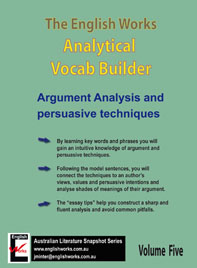
In an opinion piece, you must base your analysis of around the “viewpoints” – what is the viewpoint we must “share”.
  • Without a “viewpoint that we must share”, you are summarising and story-telling.
  • You must show an ability to distinguish between background details and contextual factors and the message itself.
  • The more specific you are with the viewpoints/call to action/meaning of the opinion text, the better your analysis.  This is the only way to minimise generic sentences.
  • Your ability to zero in on main points leads to a sharper discussion – it controls/determines the “techniques” and the “language features”.
  • We need to work on clarity of expression, especially when the meaning is difficult.
  • Do not include too many quotes in a sentence and make sure your quotes fit the grammatical construction of your sentence.
  • Minimise generic sentences – sentences that lack a connection to the meaning of the text and the author’s purpose.
  • You must always connect techniques such as evidence/personal/professional experience to a viewpoint – otherwise it is generic.
  • Finally, adapt and mimic the writer’s formal style; learn to write like them. Use short, pointed sentences; nominals and active sentences.
  • Use only one difficult technical term each sentence and evaluate its purpose.

Analytical vs Summary-style sentences

  • If you are writing sentences like, the author ‘ asserts’ ‘states’ ‘highlights’ –  then you are summarising and paraphrasing.
  • See pages 21, 41, 43, 44
  • See my write up of VCAA Responses so far .. .

Please see our program: Return to Extension Activities Summary Page

Tweet

Uncategorized

Jenny

Products

  • Placeholder 2026 Term 2 Zoom Sessions $40.00
  • Placeholder 4 Session Group Lesson $600.00
  • Placeholder Individual Lesson with Dr Jenny via PayPal $135.00
  • 2026 Term 1 Zoom-in lessons (AA and Craft) $160.00 $130.00
  • Rainbow's End by Jane Harrison: an essay-writing guide $28.95

Primary Sidebar

View all Products in this Category

Cart

Search

Footer

For Sponsorship and Other Enquiries

Please contact English Works
Ph: (061) 0400 568 657
or email:jminter@englishworks.com.au
Original artwork by Kelly Bull

Keep in touch

Search

Copyright © 2026 English Works · Log in